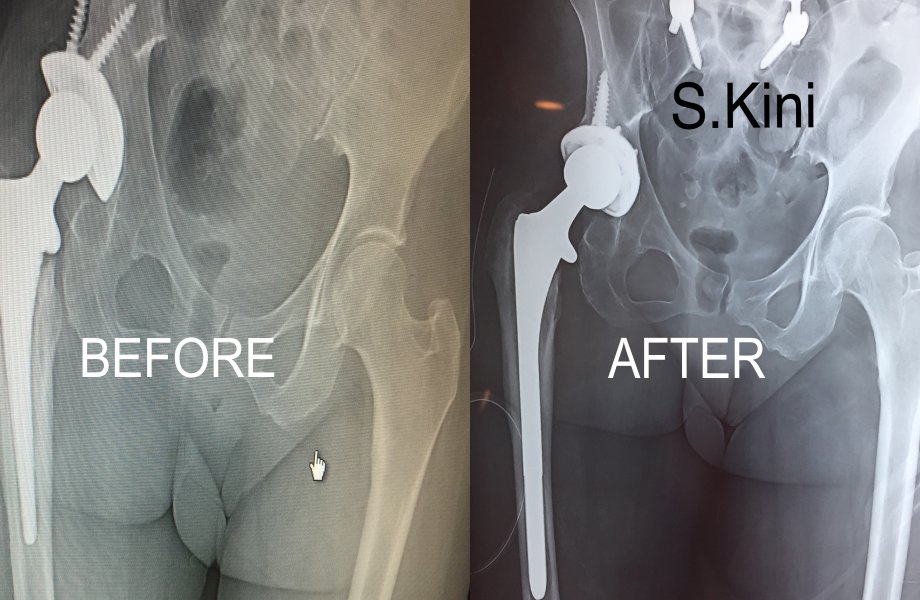
Hip Surgery / Revision Hip Replacement Surgeon IN BANGALORE
The most common cause appears to be loosening of the cement used to fix the artificial socket into the hip bone. As the socket loosens progressively, it starts to rub on or abrade the bone into which … it had been fixed. This constant rubbing has an affect much like sandpaper which cause dissolution of bone slowly over a period of time. Just as the cement surrounding the socket component becomes loose with time, so can the cement placed around the femoral component.
What is Revision Hip Replacement
There is little doubt that revision hip surgery is generally much more involved and complicated than a primary (first time) hip replacement operation. Overall, it is a more lengthy operation and associated with a higher level of risk.
Patients generally take longer to get over this type of surgery. It is however, crucial to understand that while the primary hip replacement operation is a fairly standard and predictable procedure, the revisions vary from patient to patient.
In fact it is hard to see two patients with exactly the same problem hip. The implication therefore is that solutions for patients who have failed hip replacements have to be tailored individually
Factors to consider regarding revision hip surgery
There are a number of factors to be taken into account when planning the surgery for the patient and these include:
- What is the cause of the hip failure in the first place?
- Is there an infection in the hip?
- Which of the hip replacement components have failed and need to be changed?
- What has been the consequence of the failure of the components? For example, is there bone loss?
- Is the remaining bone stock enough to anchor the new replacement components? If there is significant bone loss then how is that to be made up or circumvented?
- How have the implants been fixed in the first place? Has cement been used or not?
- Can the implants be removed without causing damage to the bone and soft tissues?
General precautions
Listed below are some precautions to be taken particularly in the first 6-8 weeks are. Your physiotherapist will discuss these and others with you in greater detail prior to your discharge from hospital as well as during your follow up visits post surgery.
- Contact your doctor if you notice any redness, leaking fluid or have an increased pain in the operated area
- Do not bend the hip more than a right angle as this could cause the hip to dislocate or pop out of the joint.
- Avoid low chairs and toilet seats
- Do not bend down to the floor to pick up objects.
- Do not force the hip to bend to reach your toes such as to clip your toe nails or put on your stockings.
- Do not twist the hip.
- Do not cross your legs.
- Do not lie on your side for the first 6 weeks.
- In the longer term, there is a small risk of spread of infection to the hip should you have an infection anywhere else in the body, if you are undergoing an operation, internal examination or even dental work.